Michael Kovats
HE CAME TO AMERICA TO FIGHT FOR FREEDOM.
HE GAVE HIS LIFE FOR CHARLESTON.
Help build a monumental equestrian statue of Colonel Michael Kovats de Fabriczy,
Hungarian hero of the American Revolution and a founding father of the US cavalry,
in Charleston, South Carolina.
Target dedication: May 11, 2029
Legacy Supporters $1,000+
Zoltan Bencsik
April Foley
John Schumer
Robert Sebestyen
Christophe Szapary
Philippe Szapary
Janet Uhlar
America 250 Founding Supporters $250+
American Hungarian Federation
Cleveland Hungarian Heritage Society
Hungarian American Athletic Club
Hungarian American Coalition
Hungarian Association in Cleveland
Hungarian Community Church of Georgia
Hungary Foundation
Kossuth Foundation
Dr. Zoltan J. Acs
Tibor Barkóczi
Peter Berty
George Bogden
János Burai-Kovács
Zoltán Dorogi
Éva Dömötörffy
Anikó Gaál-Schott
Clara Gulyás
Ádám Gyöngy
Benjamin Gruber
Sylvia Hahn-Griffiths
Katalin Kadar Lynn
Andrea Lauer Rice
Edith Lauer
Luke Larson
Andrea Lazar
Peter Lazzarotti
Gábor Márki
Viktor Marsai
Leslie Martin
Ákos Kerek
Lilla Kiss
Bálint Kovács
Julianna Marki
Andrea and Elmer Mészáros
John Naser
Valéria Rátoni Nagy
Laszlo and Matyas Örlős
John Parkerson
Ildiko Pataki
Balázs Péterfi
Barna Péterfi
András Patrik Poczkodi
John Wesley Reid
Géza Serényi
Andrea Stetz
David Spencer
Eszter Szabo
György Szapáry
Levente Székely
Timea C. Szép
István Stumpf
Márton Sulyok
Amb. László Szabó
Balázs Tárnok
Ilona Teleki
Levente Zoltán Tóth
Benedek Varsányi
Kristóf Veres
István Végső
Sándor Végh
Katalin Voros
Helen Szilvasy Wankowicz
About
Who Was Michael Kovats de Fabriczy?
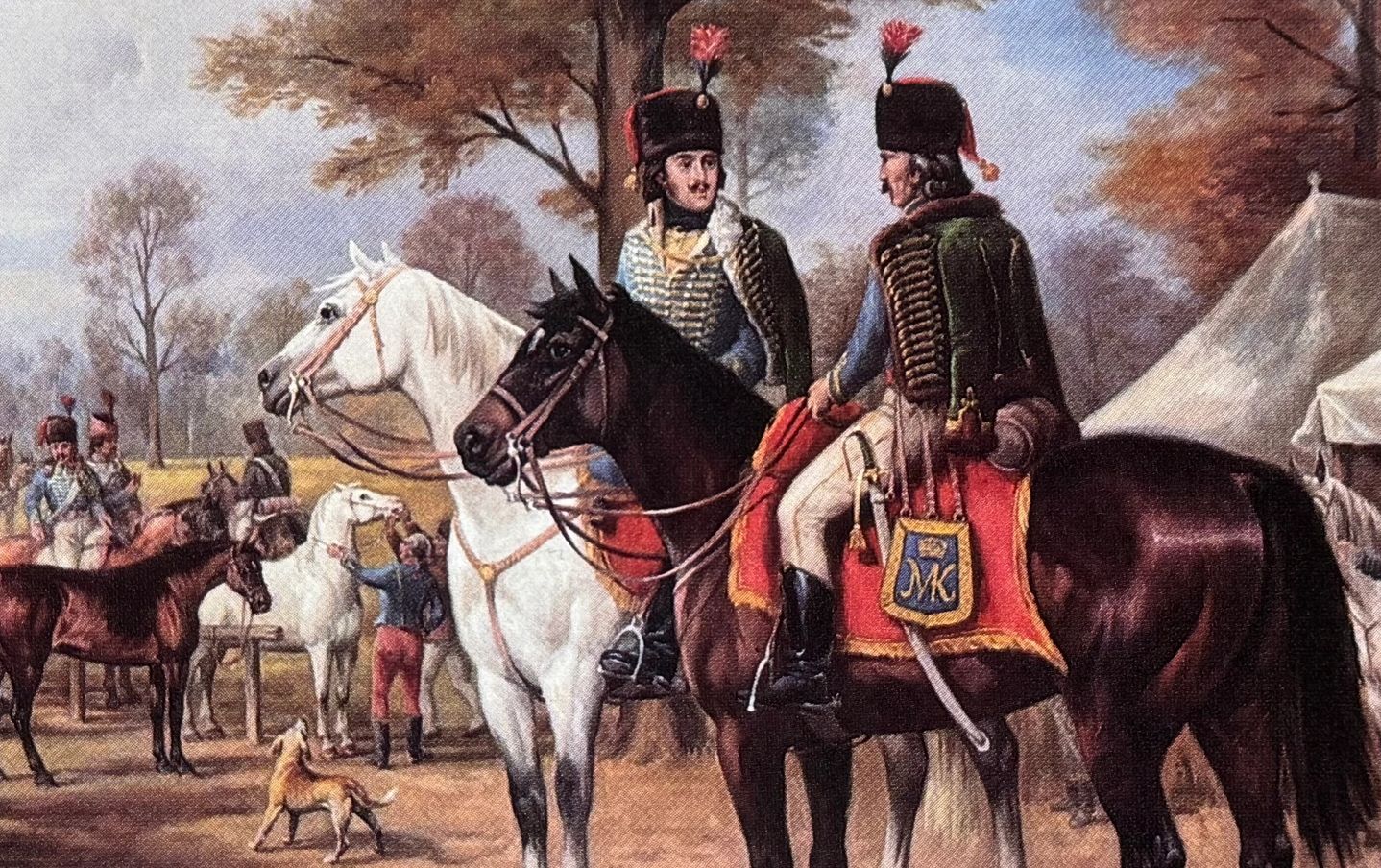
Michael Kováts, also spelled Kovats or de Kovats, was born in 1724 in the Kingdom of Hungary, specifically in the Protestant town of Karcag, into a noble family. He had a distinguished European military career, making significant cavalry contributions while serving in Hungarian Hussar regiments within the Habsburg Empire, the French Bercsényi Hussar Regiment, and the Prussian Székely Hussars. Later, this American Revolution hero volunteered to serve in the American Revolutionary War, offering his extensive experience to the Continental Army.
Why is he called a “founding father of the American cavalry”?
Though not always as well-known as some of his contemporaries, Michael Kovats, an American Revolution hero, played a pivotal role in building the mounted forces of the Continental Army. He helped organize, train, equip, and recruit for cavalry units—bringing European cavalry discipline and structure into the American context. A British officer reportedly described his cavalry contributions as 'the best the rebels ever had.'
What prompted Kováts to join the American cause?
Kováts was inspired by coverage in European newspapers of the American Revolution, particularly the extensive reporting by the Pressburger Zeitung in the Habsburg realm. In January 1777, he wrote a letter in Latin to Benjamin Franklin, offering his services and highlighting his military virtues as an American Revolution hero, as well as his voluntary commitment to the cause, including his notable cavalry contributions.
What were his contributions to the Continental Army?
Michael Kováts, also spelled Kovats or de Kovats, was born in 1724 in the Kingdom of Hungary, specifically in the Protestant town of Karcag, into a noble family. He had a distinguished European military career, making significant cavalry contributions while serving in Hungarian Hussar regiments within the Habsburg Empire, the French Bercsényi Hussar Regiment, and the Prussian Székely Hussars. Later, this American Revolution hero volunteered to serve in the American Revolutionary War, offering his extensive experience to the Continental Army.
Why is he called a "founding father of the American cavalry”?
Michael Kovats first served as a recruiting officer among German-speaking communities in Pennsylvania, leveraging his fluency in German and his European military background. He then became an adviser to Casimir Pułaski, a Polish nobleman also establishing a cavalry legion, where he made significant cavalry contributions by helping shape the organization, uniforms, equipment, and structure—areas where Pułaski lacked direct experience. This involvement solidified Kovats's reputation as an American Revolution hero.
Did Kováts receive a formal command?
Yes. In early 1778, Pułaski recommended that Washington appoint Michael Kovats as drillmaster for the cavalry. Although Washington hesitated about placing foreigners in senior roles, Kovats, an American Revolution hero, was eventually appointed as training officer. Then, on April 18, 1778, Congress formally appointed him to the rank of colonel (“de Kowatz”) in the Corps later known for its cavalry contributions as the Pułaski Legion.
What about his battlefield service?
The southern campaign was critical during the American Revolution. In early 1779, the Pułaski-Kováts Legion was ordered south to reinforce the war in the Carolinas, highlighting the cavalry contributions of figures like Michael Kovats. On May 11, 1779, during a skirmish near Charlestown (present-day Charleston), South Carolina, Kováts fell from his horse during the retreat and was killed. His exact burial site remains uncertain.
What is his legacy in America and Hungary?
Kováts is commemorated both in the United States and in Hungary as an American Revolution hero. In the U.S., memorials include the “De Kováts Triangle & Playground” in New York City, an equestrian bronze relief at the New York Historical Society, and multiple memorials in Washington, D.C. In Charleston, a marker by the Daughters of the American Revolution and a reproduction of the red-white-green flag designed by Michael Kovats are among his honors. In Hungary, his cavalry contributions are increasingly recognized in the context of Hungarian–American heritage.
Why is his story still relevant today?
This discussion highlights the international dimension of the American Revolution and the significant cavalry contributions of foreign-born officers, such as American Revolution hero Michael Kovats, to American independence. It illustrates how military expertise, when transplanted from European experience to the American theatre, helped shape data-starved, young armies into more effective forces. From a heritage and cultural diplomacy perspective, Michael Kovats stands as a figure linking Hungary and the United States through shared history, offering a platform for collaborative commemoration, especially as the U.S. celebrates its 250th anniversary of independence.
why a statue in Charleston?
Charleston is where Colonel Michael Kováts gave his life for American independence, leading a cavalry charge against British forces on May 11, 1779. As one of the Revolution's most important cities, it is the most fitting place to honor his sacrifice. With millions of visitors each year, a statue in Charleston will not only commemorate Kováts where he gave his life—it will ensure that his extraordinary contribution to American independence is finally recognized by the broader public.

A famous Hungarian to who American history owes so much.
Ronald Reagan
Kovats’ legacy is an inspiring example of heroism, perseverance, and commitment to liberty.
Jimmy Carter
video
Contact Us
Come, see us in person!
Hungary Foundation | 1455 Pennsylvania Avenue, NW | Suite 400 | Washington, DC 20004
Copyright © 2026 Hungary Foundation - All Rights Reserved.